Mental overload
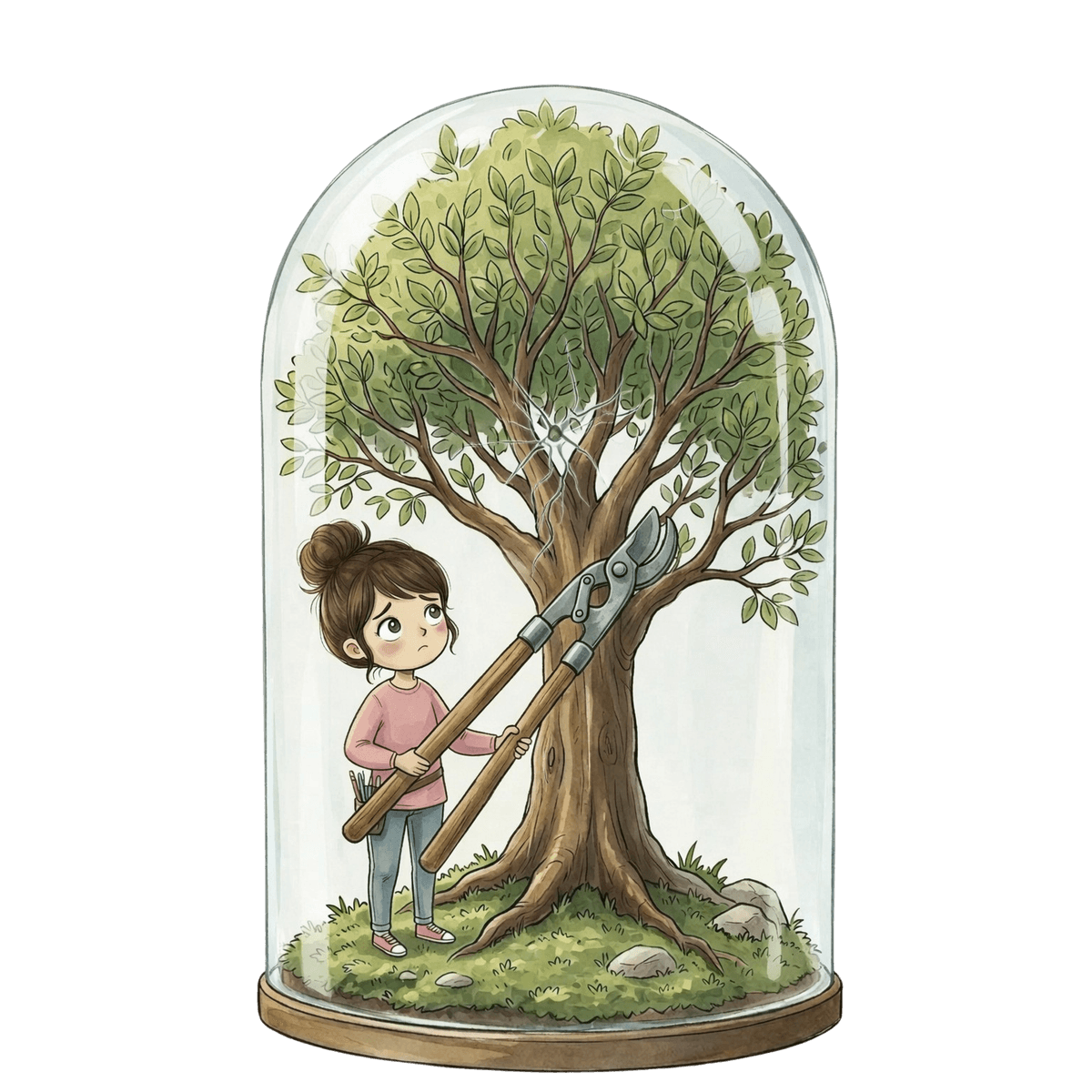
Do you ever feel like your mind is hopping from one thought to the next? You start thinking about something, and instantly several possible next steps appear. Each of those steps opens more possibilities. Every option leads to another small branch of "what ifs" and "maybe this instead".
Then you remember something someone said to you, or another idea crosses your mind, and suddenly there are even more directions to consider. The thoughts keep multiplying, and you spend your time weighing them, comparing them, trying to figure out which one would lead to the best outcome.
You might find yourself jumping from one idea to another, without making any real progress on any of them.
When racing thoughts turn into too many choices
One way to describe this state is to imagine a tree growing inside a glass dome. The dome protects the tree, but it also limits how large it can become. If the tree grows too much and no branches are trimmed, it eventually begins to press against the glass. If the pressure keeps building, the dome can crack, and the tree may end up destroying the very space that keeps it alive.
Now imagine how that tree begins to grow. It starts with a single branch, an initial thought. From that branch, several others quickly appear, each representing a possible next step. Naturally, you begin to think about those steps. You analyze every angle, imagine different outcomes, compare paths, and try to calculate the best possible move, hoping to make the perfect cut. But the very act of examining them keeps the tree expanding. Every attempt to follow a path creates new variations, new possibilities to consider. What began as a single thought quickly turns into a spreading structure of possibilities.
At that point, the mind tries to solve the problem by thinking harder. Instead of cutting the branches in reality, you begin cutting them mentally.
Yet branches are not reduced by thinking about them. They are reduced by action. The more time you spend trying to mentally trim the tree, the less time you have to actually cut it. As thinking increases and action decreases, the tree keeps growing, gradually filling the space inside the dome. The system becomes crowded, the structure starts to strain, and the pressure builds. That is the moment when everything begins to feel overwhelming. The more you think, the more there is to think about. It becomes a cycle of endless possibilities that keeps you stuck in your thoughts and leaves no time for action.
Overanalyzing in an attempt to control the outcome
Thinking itself is not the problem. We think because we want to move forward, to do something meaningful, and to choose well. In that sense, thinking is completely logical. The difficulty begins when thinking turns into a search for the best possible move. When multiple options appear, it starts to feel as if one of them must be the right one, and that it should be possible to identify it before taking action. In that moment, thinking shifts from exploration into pressure.
Behind the need to find the perfect decision, there is usually an emotional layer, even if it is not immediately visible. It can be fear of making a mistake, fear of wasting time, fear of missing a better opportunity, or fear of how a decision might reflect on us. For some, it can go deeper, into the belief that one wrong step could permanently close the path they are trying to reach. The specific emotion can differ from person to person, but the effect is similar. The next step begins to carry more weight than it actually has, and the decision starts to feel like something that needs to be secured rather than simply taken.
Because of that need for security, the mind tries to resolve the situation through more thinking. It analyzes, compares, and simulates different outcomes, attempting to predict what will happen before moving, as if it were possible to see the future clearly enough to guarantee the right choice. This feels reasonable. If the situation is complex, it seems natural that more thinking should lead to a better decision. In practice, however, thinking in this way does not reduce complexity. It generates it. Each new scenario introduces additional branches, more variables, and more possible outcomes to consider.
The system you are trying to understand is not fixed. It keeps changing as you observe it. New possibilities appear, existing ones shift, and the picture cannot be held still long enough to be fully mapped. The more you try to reach certainty, the more there is to evaluate. What began as an attempt to avoid a mistake becomes a bigger issue. By thinking more, you end up acting less, which leads to stagnation. And the only thing that truly does not move you forward is doing nothing.
Getting unstuck when thinking takes over
The goal is not to eliminate mental overload. It is not realistic to expect that you will never enter this state again. What changes things is how quickly you recognize it. When you notice that you are thinking more but moving less, take that as a signal to stop going deeper into analysis. That is usually the point where the system starts to loop. Instead of trying to understand everything, focus on seeing enough to act. Shift the question from what the best possible step is to which step reduces the number of options. Not the perfect cut, just a cut. In many cases, that means choosing the smallest possible move available right now.
Action does not need to resolve the whole situation. It only needs to change it. Even a small step begins to reshape the structure. The tree is no longer only growing. You are shaping it.
Don’t chase perfection, choose movement
Trying to secure every outcome before you act is what keeps the scissors frozen in your hand. The dome does not stay intact because you made the perfect cut. It holds because you were willing to cut at all, and the moment you choose, even imperfectly, the pressure begins to shift. Even if you later realize there was a better branch, it does not mean you chose badly. It means you moved.
You cannot predict the future by thinking more, and the sooner you cut a branch, the sooner you see the future you were trying to predict.