Right moment
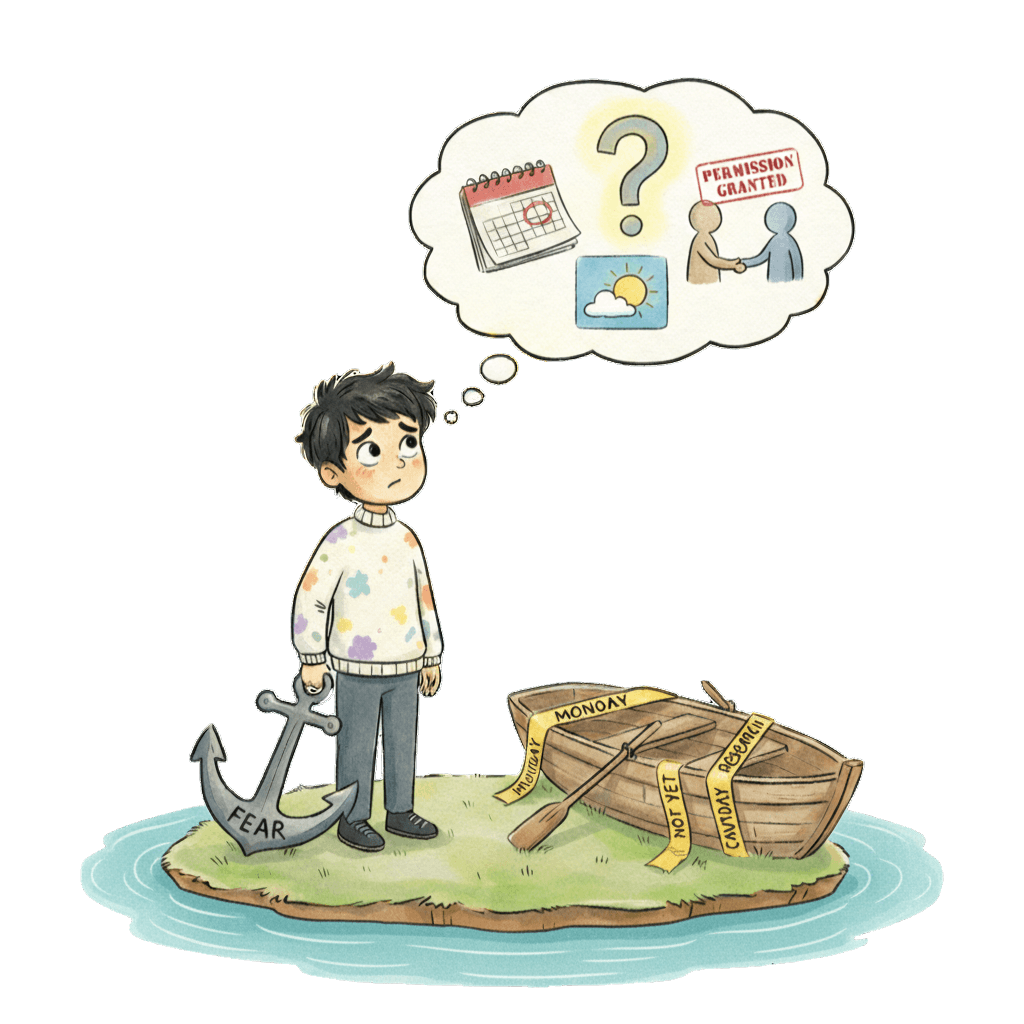
How often do you wait for the right moment?
For a Monday. A first of the month. The beginning of a year. The end of something else.
How often do you give yourself more time because something isn’t ready yet, or because of someone else? And have you ever noticed the difference between the things you postpone and the ones you can simply jump into and do?
How waiting turns into excuses
That kind of waiting doesn’t live in just one area of life. It appears in work, in relationships, in health, in the small things we promise ourselves we’ll start doing. We wait to change a job. We wait to leave a relationship that already feels finished inside. We wait to start exercising, eating differently, calling the doctor, tidying the apartment, making that one phone call we’ve been postponing for weeks.
We wait for a Monday. Next week. A first of the month. A new year. For this phase to end. As if a clean date could make the decision feel easier. As if timing could take some of the weight off taking action.
When time stops working as an excuse, people often enter the picture. We wait for someone else to change. To finally understand. To see things the way we do. We wait for someone to make the first move, or to react first, so we don’t have to be the one who disrupts the fragile sense of peace. We wait for someone else to do something for us. Something we could do ourselves, or something that doesn’t actually depend on that one specific person at all. We wait for permission, for reassurance, for someone to confirm that our choice makes sense. We wait for others to decide, to carry the consequences, to take responsibility, so we don’t have to. Action is postponed because it is expected to come from elsewhere, even when it could just as easily come from us.
Another common version of waiting looks like being busy. We prepare, improve, research, adjust. Sometimes we prepare endlessly for the very thing we already know how to do, polishing and refining without ever stepping forward. Other times, we fill our days with tasks that have nothing to do with the actual step we’re avoiding, convincing ourselves we’re just too busy right now. From the outside, it looks like movement. From the inside, the one step that would actually change something remains untouched.
There is also a subtler kind of excuse that often goes unnoticed. The one that sounds mature and careful. Wanting more clarity. More certainty. More proof that this is the right choice. We tell ourselves we are being thoughtful, not impulsive. Responsible, not rushed. And sometimes that’s true. But sometimes, it’s just waiting dressed up as careful thinking.
We also tend to wait for a sign. If this happens, then I’ll act. If they say this, then I’ll speak up. If I feel more certain, calmer, more confident, then I’ll decide. The action is placed on hold, tied to an event that is supposed to come first. And we wait for that sign until the very last moment, until the situation leaves no room anymore, and the decision becomes practically unavoidable.
And sometimes, waiting shows up when we are already almost there. When most of the work is done. When only one step remains. That is often the moment when things suddenly slow down. New tasks appear. Distractions multiply. The final step is kept just out of reach, as if leaving the outcome open a little longer feels safer than actually crossing the line.
What’s interesting is that we don’t do this with everything. There are actions we take without hesitation, without perfect timing, without checking every possible outcome. We don’t wait for signs or permission. We simply act.
And that raises an important question: why is that?
What is really behind the delay
Is it lack of courage? Laziness? Or something else entirely?
We usually reach for simple explanations. A lack of discipline. Not enough motivation. Too little courage. We tell ourselves that if we were just a bit braver, more organized, or more driven, we would act. That this is a character flaw, something we should push through.
But more often, the issue isn’t a lack of will. It’s a lack of inner capacity. The capacity to tolerate certain feelings, consequences, or shifts that action would bring. When that capacity isn’t there yet, the mind looks for something outside of us to lean on. Time. Circumstances. Other people.
We start with these explanations because they are conscious, reasonable, and safe. They are easier to name, and they allow us to stay in familiar territory, to make sense of what’s happening without having to look too closely at ourselves. Meanwhile, the real issue stays unnoticed, operating quietly in the background, outside of what we are ready to see.
Overthinking can keep us occupied while we avoid a step that feels too exposed. Intuition can get tangled with anxiety, making us question what we already sense. Blaming timing or other people can feel safer than acknowledging our own role. Fear of conflict, loss, or being wrong quietly shapes the delay. And staying in potential can feel safer than becoming concrete, because as long as something lives only in our head, there is no proof we might be wrong.
Each of these looks different on the surface, but they all point to the same thing. Waiting is not random. It appears exactly where something feels too much to carry alone.
That’s also why some actions feel easy. Not because they matter less, but because they don’t activate anything fragile underneath. They don’t touch our hidden fears, our sense of identity, or the parts of us that feel unsteady. There is nothing internal that needs to be carried, defended, or risked.
Waiting is not for free
We often tell ourselves that waiting is harmless, that taking time is normal, sometimes even smart. And sometimes, it really is.
Not all waiting is the same. There is waiting that comes from processing, when something needs to settle, when emotions need space, when clarity is still forming. That kind of waiting has direction. It changes something inside us.
But if we start noticing that our waiting is repetitive, the same thoughts, the same conditions, the same reasons, then that waiting is no longer neutral. It becomes a way of pointing outward instead of turning inward, of finding external explanations instead of recognizing what is actually stopping us.
And that kind of waiting is not for free.
Think about something from your past that you knew long before you acted on it, something you were aware of, but kept postponing. And when you finally did it, there was probably that familiar thought: If only I had done this earlier… what else could have happened?
That doesn’t mean that time was wasted. At that point, it was your pace, your capacity, your level of readiness. You learned things, you changed, life moved you along its own path.
Still, there is a difference between letting life teach us at its own pace, and choosing to step in and look at what is really keeping us stuck.
Recognize what is really holding you back
If you notice that you keep waiting for time, for other people, or for circumstances to change, it’s worth stopping and asking why you are stuck. It’s much easier to blame external factors, but far more valuable to recognize what you are actually protecting yourself from.
Noticing and naming your reason is already a step forward. It turns waiting from avoidance into awareness.
And once we recognise what is really holding us back, we no longer need excuses or better timing. Every moment becomes the right moment.